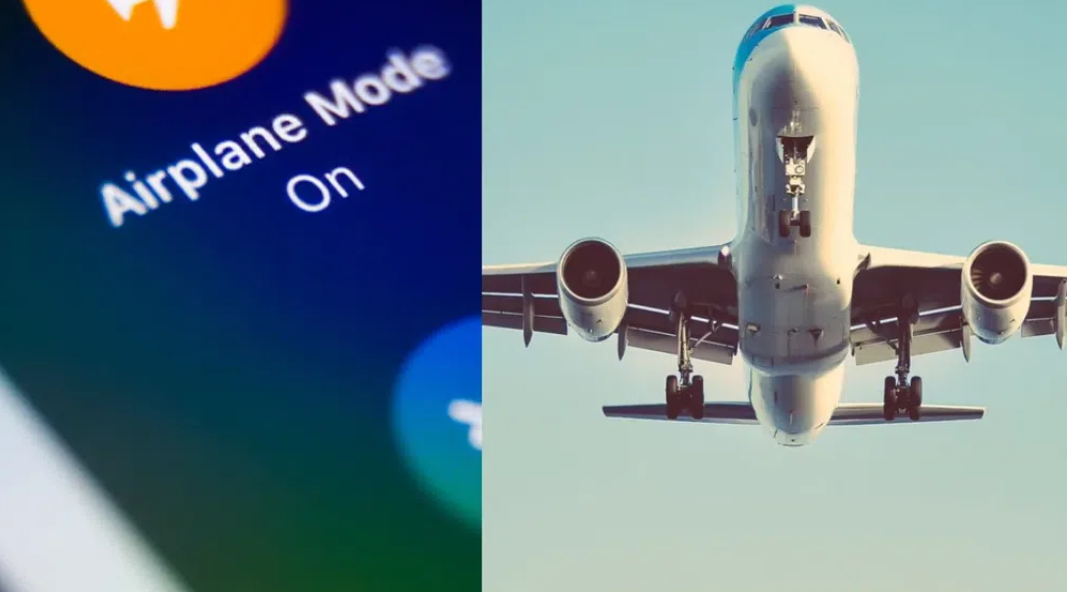
Does Airplane Mode Really Matter for Flight Safety? Here’s the Truth
If you’ve been on social media in the last 48 hours, you’ve probably seen the video of an Ibom Air passenger who refused to turn off her phone.
The crew insisted, the woman stood her ground, voices were raised, and before we knew it, there was a full-blown in-flight ruckus.
Why is this even a big deal? Isn’t airplane mode just one of those unnecessary rules airlines love to shout about? Well, no. Here’s why it’s super important.
If you’ve ever flown on a commercial airplane, you’ve definitely heard the announcement: “Please switch your electronic devices to airplane mode.”
But have you ever wondered why that’s necessary?
Let’s break down the reasons airlines still require passengers to enable airplane mode—even in this age of advanced technology.
1. Preventing interference with aircraft systems
Airplanes rely on sensitive navigation and communication systems to operate safely. Meanwhile, your mobile phone emits radio signals as it tries to connect to cell towers.
While a single phone is unlikely to cause a major issue, hundreds of devices transmitting at once can create a high level of electromagnetic noise. This can potentially interfere with pilot communications or onboard systems—especially during critical phases of flight, like takeoff and landing.
2. Regulatory requirements still enforce it
Aviation authorities like the Federal Aviation Administration (FAA) in the U.S. and the European Union Aviation Safety Agency (EASA) mandate the use of airplane mode during flights. These rules are in place as a safety precaution to prevent any possibility of interference and ensure secure and efficient air traffic operations.
Even if newer aircraft are shielded against signal interference, regulations still err on the side of caution.
3. Your phone won’t connect anyway
At 30,000 feet, your phone is moving too fast and flying too high to maintain a stable connection with ground-based cell towers. When it can’t connect, your device starts searching for a signal continuously, draining your battery and emitting stronger radio signals—which just adds more noise to the cabin.
So even if you could connect, the experience would be spotty at best—and it’s not worth the trade-off in battery life or potential interference.
4. It saves your battery and reduces device stress
Constantly hunting for a signal while airborne leads to significant battery drain. Airplane mode turns off your phone’s cellular radio, helping preserve your battery for when you actually land and need it.
In addition, it helps prevent your phone from overheating, which is useful when you’re stuck in a full cabin with little ventilation.
5. You can still use Wi-Fi and bluetooth
Modern airplane mode is flexible. While it disables the cellular connection, you can manually enable Wi-Fi and Bluetooth after switching it on. Many airlines now offer in-flight Wi-Fi for messaging, streaming, and browsing, along with Bluetooth support for wireless headphones.
So you’re not completely cut off from the digital world—you’re just flying a little smarter.
The takeaway
Switching to airplane mode isn’t just an outdated rule—it’s a smart, safety-first policy that:
-
Minimizes potential interference,
-
Complies with international aviation regulations,
-
Preserves your battery and improves performance,
-
And still lets you stay connected via Wi-Fi.
So the next time you hear the cabin crew’s request, you’ll know it’s not just a formality. It’s a small step that helps ensure a smooth, safe journey for everyone on board.

You May Also Like

These 3 Zodiac Signs Are Kind-Hearted People
January 31, 2021
These Foods Are Proven To Be The Most Addictive, According To Science
March 7, 2025